Hospital Medical Waste Treatment Systems
Integrated Autoclave with Shredder – MWI Series
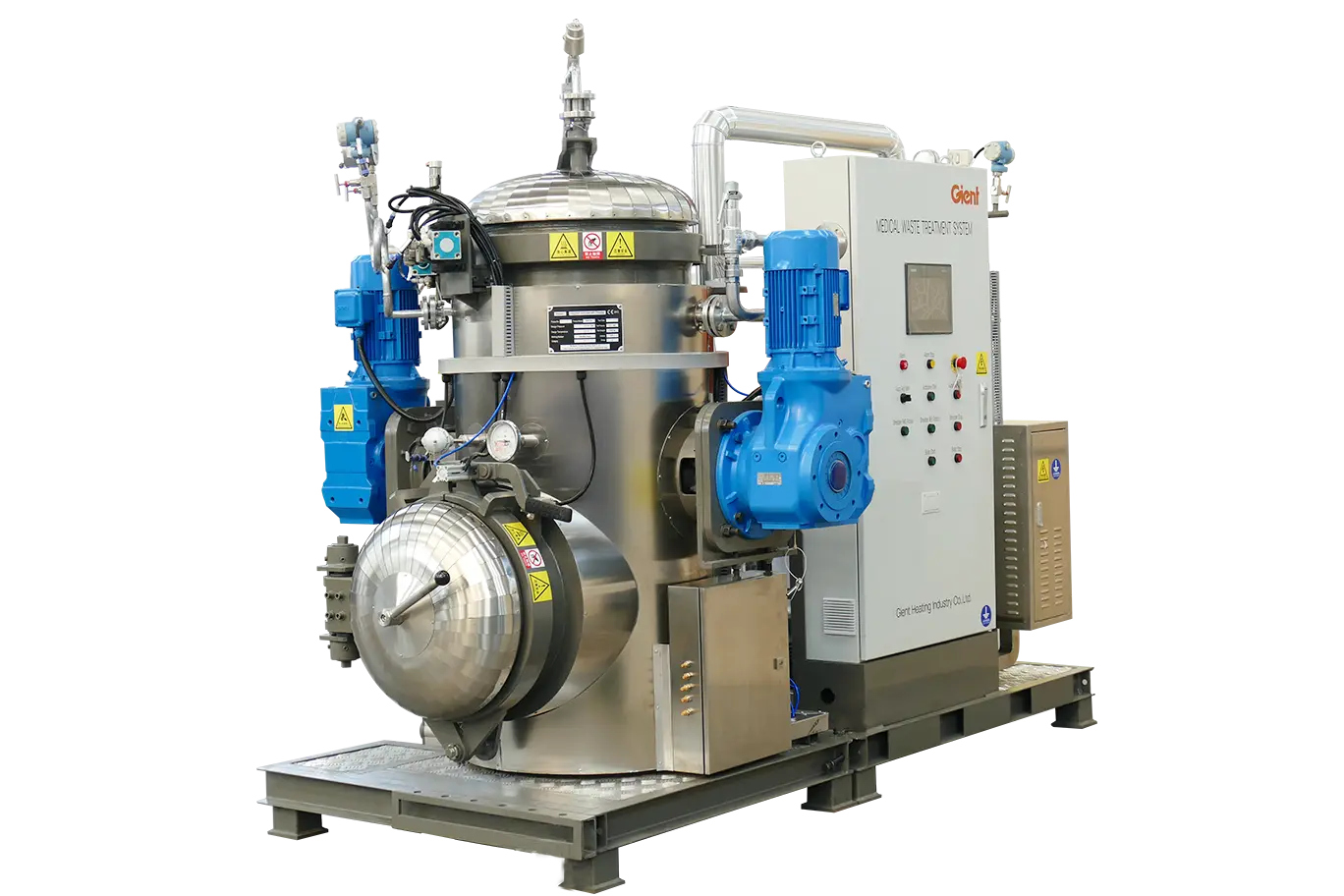

Application
Onsite medical waste treatment in hospitals and healthcare centers

Capacity
Effective loading volume per cycle: 100L, 200L, 300L, 500L, etc. (More capacity please inquiry Gient)

Working type
Shredding prior to sterilization, built-in double-shaft shredder in autoclave

Temperature and pressure
134-138°C, 2-3 bar (adjustable)

Microbial inactivation
STAATT IV and 99.999999% (8Log10)

Waste volume reduction
80% (depending on waste)
I. Hospital Medical Waste Treatment Systems for Safe and On-Site Disposal
Hospital medical waste treatment refers to the safe handling, sterilization, and disposal of infectious and hazardous waste generated within healthcare facilities such as hospitals, medical centers and laboratories. This type of waste may contain pathogens, and contaminated materials that pose significant risks to public health and the environment if not properly treated.
Effective hospital medical waste treatment systems are essential to eliminate infection risks at the source, ensure compliance with healthcare regulations, and reduce environmental impact.
WHO‘s “proximity” principle recommends that treatment and disposal of hazardous waste occur as close as possible to its source to minimize the risks associated with transportation,improving both safety and efficiency.
II. Why Hospitals Need On-Site Medical Waste Treatment
On-site treatment is specially necessary where off-site treatment is not available or not appropriate.
• Infection Control: Immediate treatment at the source eliminates risks associated with storage and off-site transportation of infectious waste
• Operational Safety: Reduces manual handling and minimizes exposure risks for healthcare workers
• Regulatory Compliance: Supports compliance with international healthcare waste management and environmental standards
• Sustainability: Reduces carbon emissions and environmental footprint associated with waste logistics
III. On-Site Medical Waste Treatment Systems for Hospitals
Gient provides advanced hospital medical waste treatment systems designed for safe, efficient, and reliable on-site processing of infectious waste. These systems are based on integrated autoclave with shredder technology, combining mechanical waste destroying and high-temperature steam sterilization within a single pressure-sealed unit.
This integrated approach ensures complete pathogen inactivation without hazardous substances emitting. After treatment, the waste becomes destroyed and non-hazardous, allowing it to be safely disposed of as general waste in accordance with regulatory requirements.
Typical applications include:
• Hospitals and large healthcare facilities
• Regional medical centers
• Laboratories and research institutions
• Emergency and mobile treatment units
IV. Key Advantages of Gient Integrated Autoclave with Shredder
Shredding breaks closed and sealed waste and increases surface area, allowing steam to penetrate effectively and ensuring reliable pathogen destruction. Validated performance reaches uniformly STAATT Level IV and 8log10 reduction, eliminating infection risks.
Built for demanding hospital environments, the system combines a robust mechanical structure with proven heavy-duty double-shaft shredder to destroy various waste and with corrosion-resistant technique to handle chloride-rich medical waste, ensuring stable long-term performance and reduced maintenance requirements.
The fully integrated system operates automatically throughout the treatment process, minimizing manual handling and operator exposure. Remote monitoring enables real-time supervision and data tracking.
As a pressurized steam sterilization system, it eliminates harmful emissions such as dioxins and furans associated with incineration. (Know more about medical waste incineration). The fully enclosed design prevents the release of airborne contaminants, while integrated deodorization ensures effective odor control, making it suitable for hospital environments.
Designed in accordance with WHO and UN recommendations, the system meets stringent international healthcare waste management standards.
V. Hospital Medical Waste Treatment Process
A typical hospital medical waste treatment process includes the following steps:
1. Waste Collection and Segregation – Proper classification of medical waste from general waste
2. Loading into Integrated System – Safe and sealed feeding into the autoclave with shredder
3. Automated Sterilization and Shredding – High-pressure steam sterilization combined with mechanical shredding
4. Safe Disposal – Treated waste becomes non-hazardous and can be disposed of as general waste